The Wake-Up Call: Why Agentic AI Breaks Traditional FinOps
Feb 26, 2026
𝐘𝐨𝐮𝐫 𝐚𝐠𝐞𝐧𝐭𝐬 𝐚𝐫𝐞 𝐬𝐩𝐞𝐧𝐝𝐢𝐧𝐠 𝐦𝐨𝐧𝐞𝐲 𝐲𝐨𝐮 𝐝𝐢𝐝𝐧'𝐭 𝐚𝐩𝐩𝐫𝐨𝐯𝐞.
𝐇𝐞𝐫𝐞 𝐢𝐬 𝐰𝐡𝐲 𝐲𝐨𝐮𝐫 𝐝𝐚𝐬𝐡𝐛𝐨𝐚𝐫𝐝 𝐝𝐢𝐝𝐧'𝐭 𝐜𝐚𝐭𝐜𝐡 𝐢𝐭.
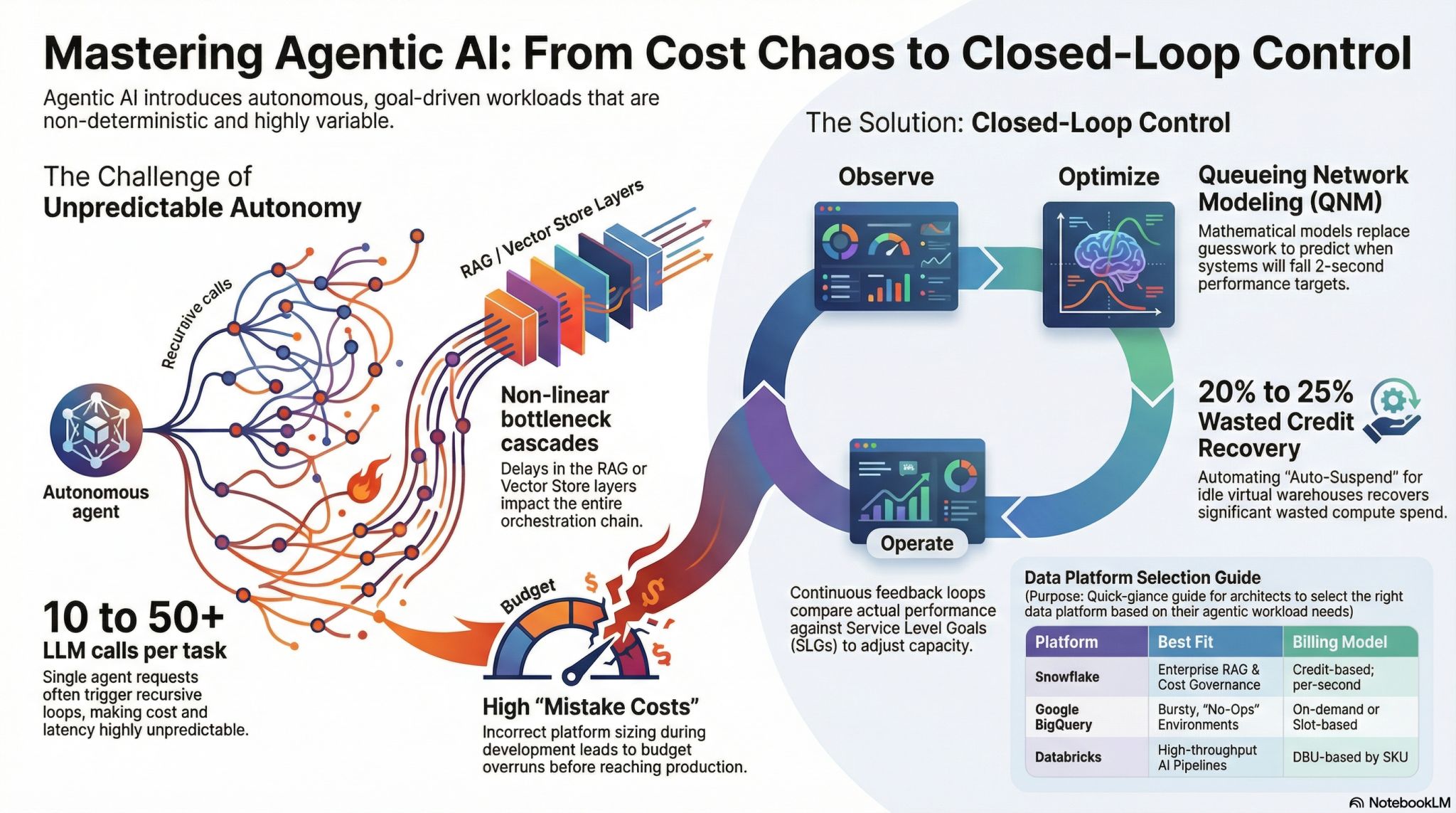
As enterprises rush to deploy autonomous agents, a quiet crisis is brewing in the cloud. While 52% of enterprises have already pushed AI agents into production, many are finding that their existing financial guardrails are fundamentally ill-equipped for this new era of autonomy.
The "bill shock" of 2026 isn't coming from a developer leaving a cluster running, it’s coming from agents making independent, recursive decisions that your standard FinOps tools were never designed to track.
The Paradigm Shift: From Deterministic to Probabilistic
Traditional software is deterministic. You write code, and it follows a fixed, predictable execution flow. You can forecast your costs because $1 + $1 always equals $2.
Agentic AI is probabilistic and goal-driven. These systems are autonomous and non-deterministic; they plan, reason, and adapt on the fly. When an agent encounters a problem, it might decide to retry a step, search for more data, or spawn sub-agents. This shift from linear code to autonomous behavior makes system performance and costs highly variable and often unpredictable.
To read more, download Boris Zibitsker's new book on Agentic AI Cost Optimization and Performance Control at https://www.beznext.com/

The Methodology – The Math Behind Predictability
𝑺𝒕𝒐𝒑 𝒈𝒖𝒆𝒔𝒔𝒊𝒏𝒈 𝒉𝒐𝒘 𝒎𝒂𝒏𝒚 𝑮𝑷𝑼𝒔 𝒚𝒐𝒖 𝒏𝒆𝒆𝒅. 𝑳𝒆𝒕 𝒕𝒉𝒆 𝒎𝒂𝒕𝒉 𝒅𝒆𝒄𝒊𝒅𝒆.
The days of "guesstimating" cloud capacity are over. To tame the variable cost of Agentic AI, you need rigorous engineering, not intuition. This requires applying a proven mathematical framework to your infrastructure: the Observe-Optimize-Operate cycle .
𝐓𝐡𝐞 𝐒𝐞𝐜𝐫𝐞𝐭 𝐒𝐚𝐮𝐜𝐞: 𝐐𝐍𝐌 & 𝐆𝐫𝐚𝐝𝐢𝐞𝐧𝐭 𝐎𝐩𝐭𝐢𝐦𝐢𝐳𝐚𝐭𝐢𝐨𝐧
How do you predict the behavior of an agent that hasn't run yet? You model it.
Queueing Network Models (QNM): Think of your system as a traffic network. QNMs simulate how requests move through "intersections" (LLMs, Vector DBs), mathematically predicting bottlenecks before deployment .
Gradient Optimization: This algorithm acts as the traffic planner. It iteratively adjusts configurations—adding memory here, changing an instance type there—until it finds the precise "sweet spot" that meets Service Level Goals (SLGs) without waste .
𝐓𝐡𝐞 "𝐌𝐢𝐧𝐢𝐦𝐮𝐦 𝐂𝐨𝐧𝐟𝐢𝐠𝐮𝐫𝐚𝐭𝐢𝐨𝐧": 𝐘𝐨𝐮𝐫 𝐑𝐎𝐈 𝐄𝐧𝐠𝐢𝐧𝐞
Enterprises chronically overprovision, buying "XL" clusters just to be safe. Optimization flips the script. It mathematically proves the Minimum Configuration needed to handle peak loads, ensuring you only pay for the exact hardware required to meet your goals—and nothing more .
𝐈𝐧𝐭𝐞𝐠𝐫𝐚𝐭𝐞𝐝 𝐎𝐩𝐬: 𝐁𝐫𝐞𝐚𝐤𝐢𝐧𝐠 𝐭𝐡𝐞 𝐒𝐢𝐥𝐨𝐬
This methodology fails in isolation. Success requires converging FinOps, DevOps, and DataOps. Without this integration, you get "siloed optimization"—where a developer improves code speed but accidentally spikes storage costs .
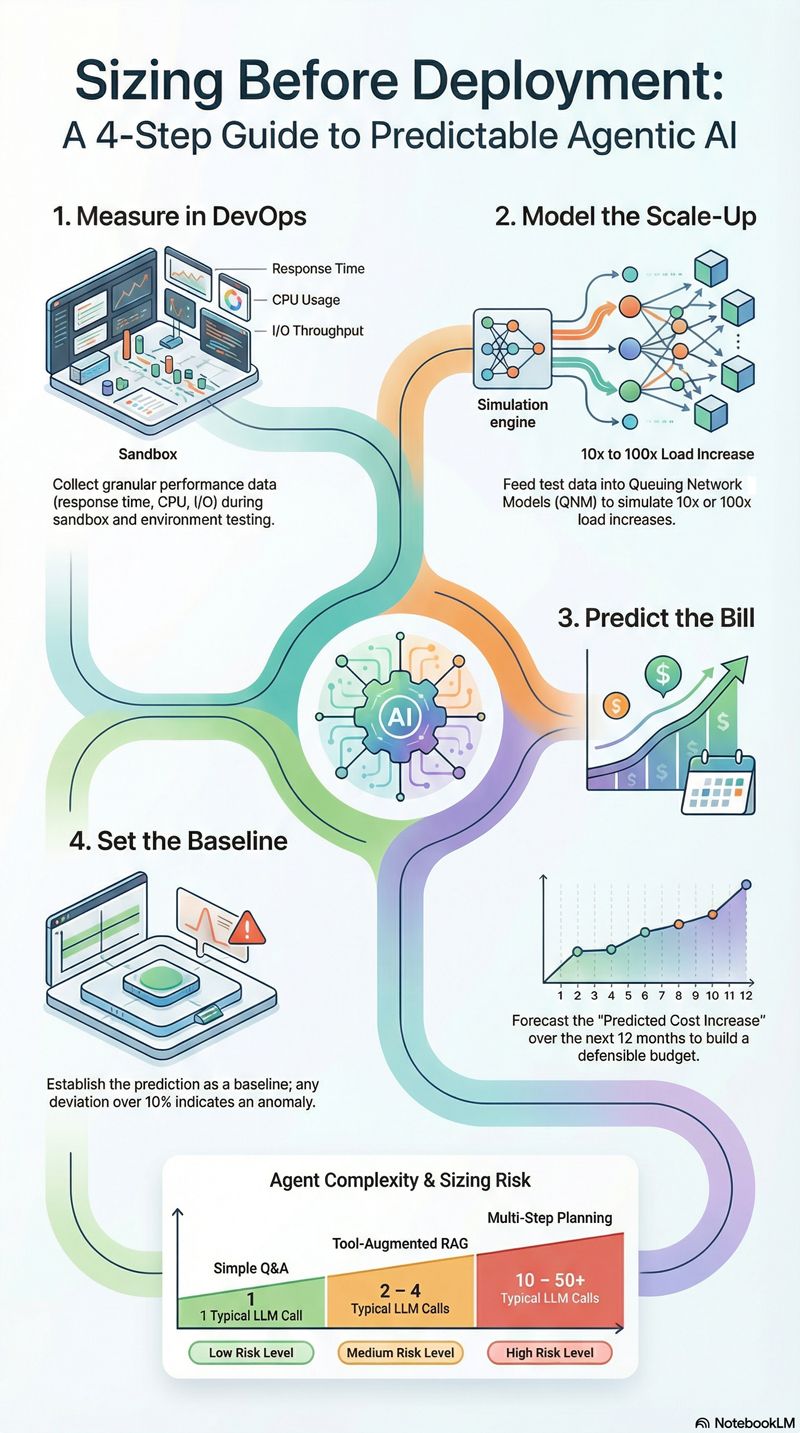
𝘈𝘤𝘵𝘪𝘰𝘯𝘢𝘣𝘭𝘦 𝘛𝘢𝘬𝘦𝘢𝘸𝘢𝘺: 𝘚𝘪𝘻𝘪𝘯𝘨 𝘉𝘦𝘧𝘰𝘳𝘦 𝘋𝘦𝘱𝘭𝘰𝘺𝘮𝘦𝘯𝘵
Stop waiting for production bills. Use data from your DevOps phase to predict costs .
Measure performance during testing.
Model scale-up scenarios (10x-100x load).
Forecast your 12-month budget before you ever push to live .
Interested in reading more, download Boris Zibitsker's new book on Agentic AI Cost Optimization and Performance Control at https://www.beznext.com/
The Proof is in the Math: How to Make Agentic AI Predictable?
Talking more about the new book my colleague Dr. Boris Zibitsker recently published. I wanted to move from theory to results.
The book talked about why autonomous agents break traditional FinOps and the mathematical framework needed to model them. Now, the critical question is does this actually work in production?
The answer lies in shifting from "guesstimation" to engineering analytics. When organizations apply Queueing Network Models and automated observability, they stop reacting to bill shock and start proactively managing it.
The data shows you, when you close the loop, budgeting reality vs. history. Traditional budgeting relies on historical trend lines, which fail when AI workloads scale exponentially. By switching to SLG-based forecasting, organizations are predicting the budget for new agents before a single line of new code is deployed into production.
Real-world case studies in the book demonstrated that by continuously comparing predicted costs against actuals, enterprises are keeping variance within 10%, flagging anomalies the moment they occur and are able to stay in control of their cost and optimize their performance.
Handling the Spikes, such as seasonal peaks like Black Friday often lead to permanent over-provisioning. Dynamic Capacity Management uses these models to predict exactly when to scale up and, more importantly, when to scale back down, preventing waste during quiet periods .
Of course choosing your platform is also not simple. If you are struggling to match a platform to your specific agentic workload, the book suggests that you consider this heuristic based analysis :
For Predictability & Governance: Snowflake or Teradata offer the strongest isolation and cost controls.
For Elastic Scaling: Google BigQuery excels at handling bursty, unpredictable RAG workloads.
For Complex AI Pipelines: Databricks is the choice for engineering-heavy, hybrid environments.
For Security & Embedded AI: Oracle provides deep integration for highly regulated industries.
Rigorous engineering of engineering analytics can turn Agentic AI from a financial risk into a predictable business asset.
Interested in reading more, you can download Boris Zibitsker's new book on Agentic AI Cost Optimization and Performance Control at https://www.beznext.com/
PS - I wanted to understand better and to make it easier for others to understand important concepts in Agentic AI orchestration and so here is Google's NotebookLM's visual aid that conceptualizes this aspect of the book, let me know what you think.
#AgenticAI #FinOps #CloudStrategy #AI #DataEngineering #Snowflake #BigQuery